

Something remarkable is happening at the intersection of artificial intelligence, open-source development, and online gaming. World of Claudecraft affectionately shortened to WoC has burst onto the scene as one of the most fascinating community-driven game experiments of 2025 and 2026. Built almost entirely by AI agents in a matter of days, then supercharged by a rapidly growing army of volunteer developers, this browser-based micro-MMO is proving that the future of gaming might not belong to hundred-million-dollar studios at all. It might belong to the crowd.
In this deep-dive we cover what World of Claudecraft actually is, how it was built, what you can do inside the game right now, how the $WOC token on Solana fits into the picture, and most importantly why this project is resonating with thousands of people who have never even touched a line of code. Whether you are a veteran MMORPG player, a blockchain enthusiast, or simply someone curious about where AI-generated software is headed, this is a story worth knowing.
What Is World of Claudecraft?
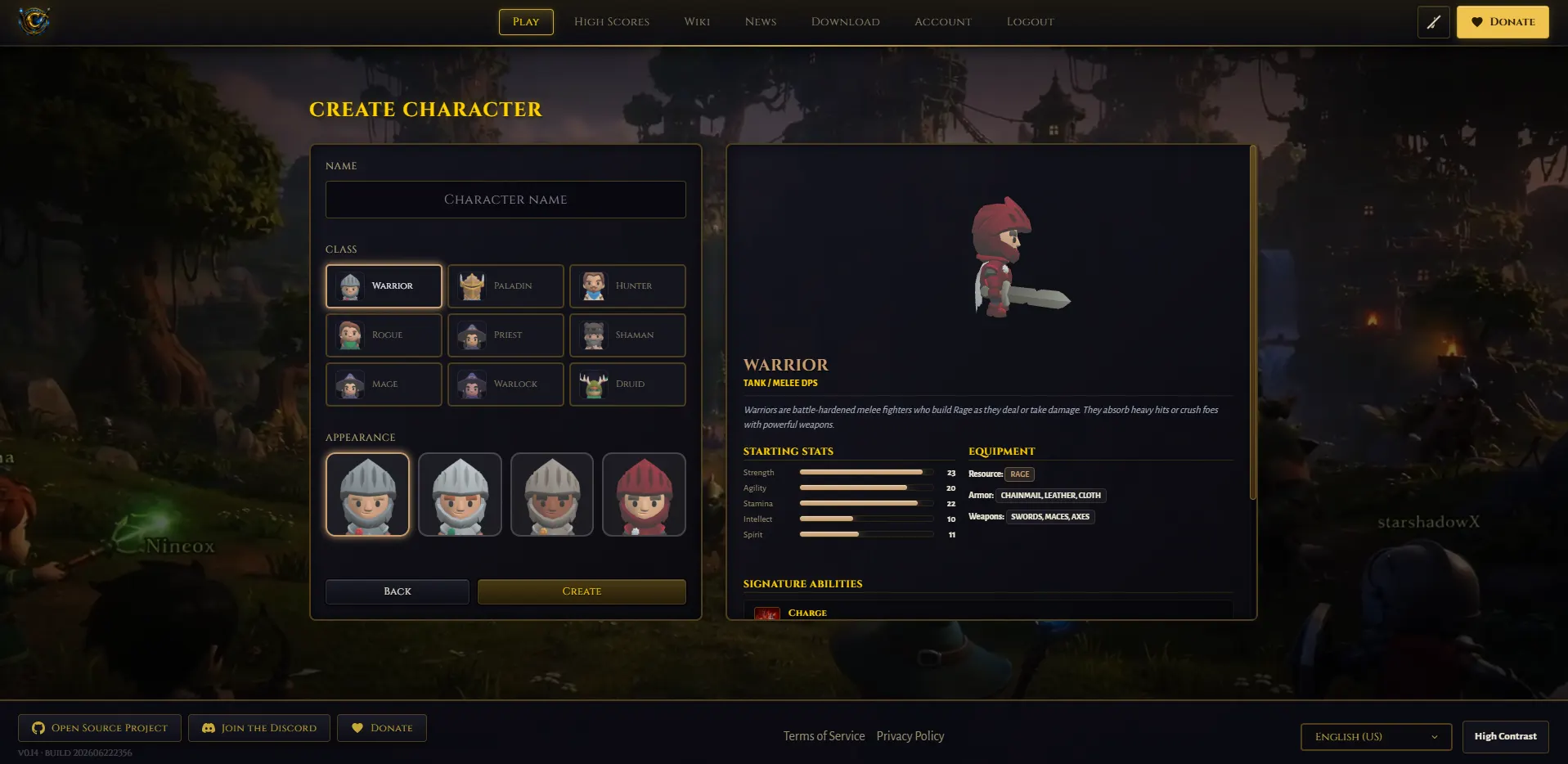
World of Claudecraft is a free, open-source, browser-based MMORPG that draws heavy inspiration from classic World of Warcraft gameplay. The name is a playful mashup: "Claude" references Anthropic's Claude AI, the primary engine that was used to generate the game's initial codebase at extraordinary speed, and "craft" nods to the legendary Blizzard franchise that defined an entire era of online gaming.
Unlike most games with a "beta" label slapped on them for years, World of Claudecraft was genuinely playable within days of its first commit. The initial version shipped with nine distinct character classes, three open-world zones spanning levels 1 through 20, and nearly 90 quests tied together by a single connected storyline revolving around the ominous Gravecaller conspiracy. That is not a tech demo that is a game.
You can jump in right now at worldofclaudecraft.com with zero installation required. Click "Play Offline" for an instant solo session, or log in with an account to share a persistent, Postgres-backed multiplayer world with thousands of other players. The same game core powers both modes, meaning you lose nothing by starting solo and graduating to multiplayer later.
Three Zones, One Connected World
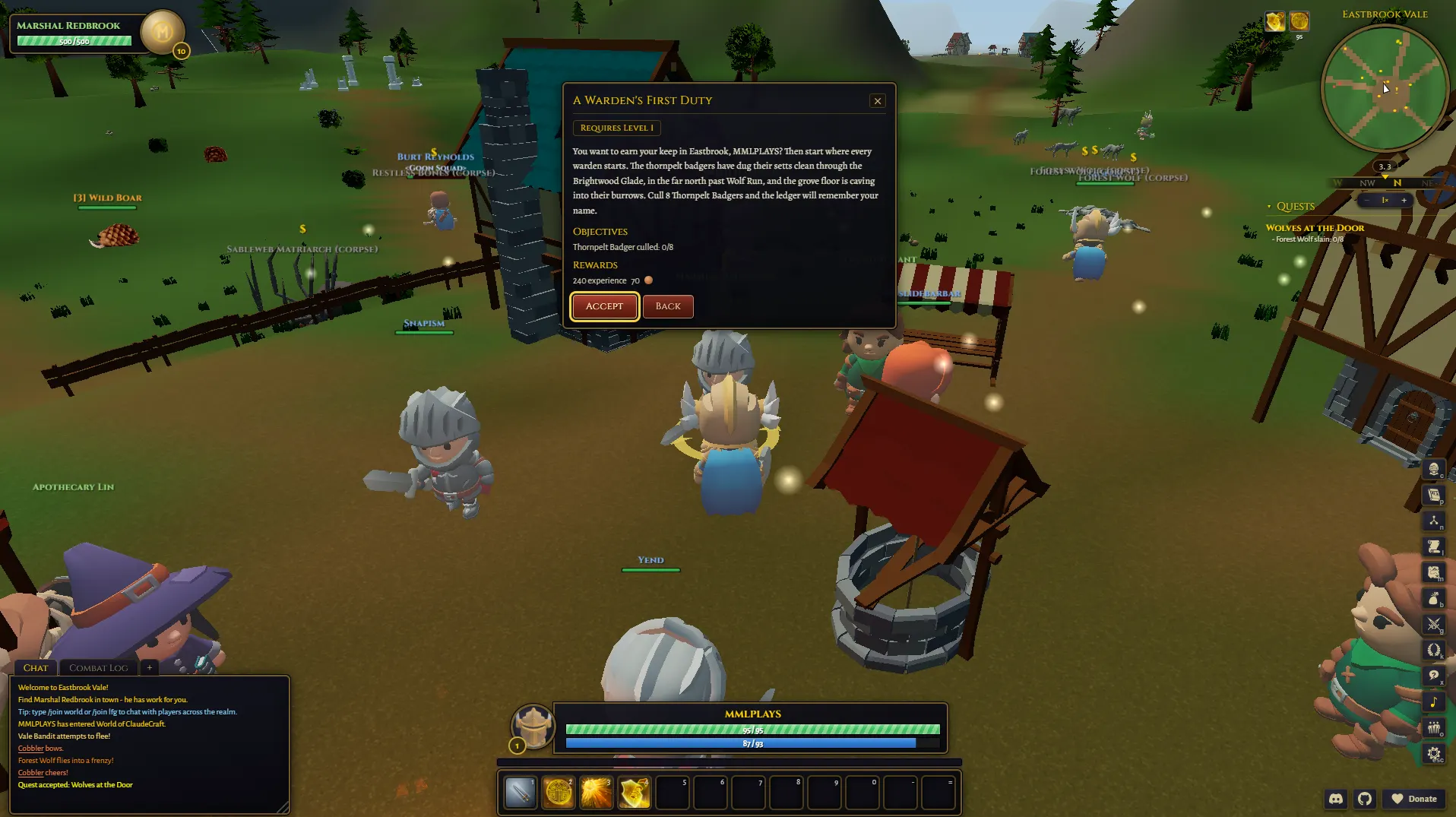
The geography of Claudecraft follows classic RPG progression logic. New characters start in Eastbrook Vale (levels 1–7), a bustling market town encircled by six distinct hubs: wolf runs to the north, boar meadows to the east, the Webwood to the west, Mirror Lake to the northwest, a kobold copper dig to the southwest, and a ruined chapel haunted by restless undead to the northeast with Gorrak's bandit camp lurking to the southeast. Each hub is distinct in feel and offers its own quest lines, keeping even the tutorial zone surprisingly rich.
Progress north and you climb through a mountain pass into Mirefen Marsh (levels 6–13), anchored by the town of Fenbridge. Keep pushing and the road eventually winds up into Thornpeak Heights (levels 13–20) and its garrison settlement of Highwatch. The world seed is fixed in the source code, so every player whether they are on the official server or hosting their own inhabits literally the same place. That shared geography creates an instant sense of shared experience that is hard to fake.
Nine Classes, Real Vanilla Mechanics
Each of the nine classes uses what the developers describe as "real vanilla-style mechanics": abilities gain ranks as you level, talent trees branch into three specialisations per class (27 specs in total), and class-defining skills like Warrior rage, Rogue Kidney Shot, Druid Starfire, and Shaman Stormstrike behave more or less as veterans of classic MMOs would expect. Warrior players manage a rage bar and land off-GCD Heroic Strikes; healers track spell ranks to manage mana efficiently across longer fights. These are not random button-mashers they require thought.
How AI Agents Built a Full MMO at Lightning Speed
The defining origin story of World of Claudecraft is how fast it appeared. Using Claude Anthropic's large language model as the primary development engine, the initial team produced a structurally complete MMORPG codebase in a timeframe that would be essentially impossible with traditional software development cycles. The project has since been described as "vibe-coded with Claude," a phrase that captures the improvisational, AI-assisted nature of its creation.
The technical architecture reflects this AI-first origin. Almost nothing in the game ships as a pre-made asset: towns, creatures, spell icons, ambient audio, and environmental details are all procedurally generated at runtime. That means the game's file size stays lean, load times remain short, and the world can theoretically be extended infinitely without ballooning asset storage a remarkable engineering achievement regardless of how it was produced.
The stack is modern and deliberately accessible to contributors. Running a local instance is as simple as
npm install followed by npm run dev, then opening localhost:5173
in a browser. Hosting a full multiplayer world with persistent accounts adds a Postgres database into the
mix but remains a one-command operation. That low barrier to entry has been critical to the project's
explosive community growth.
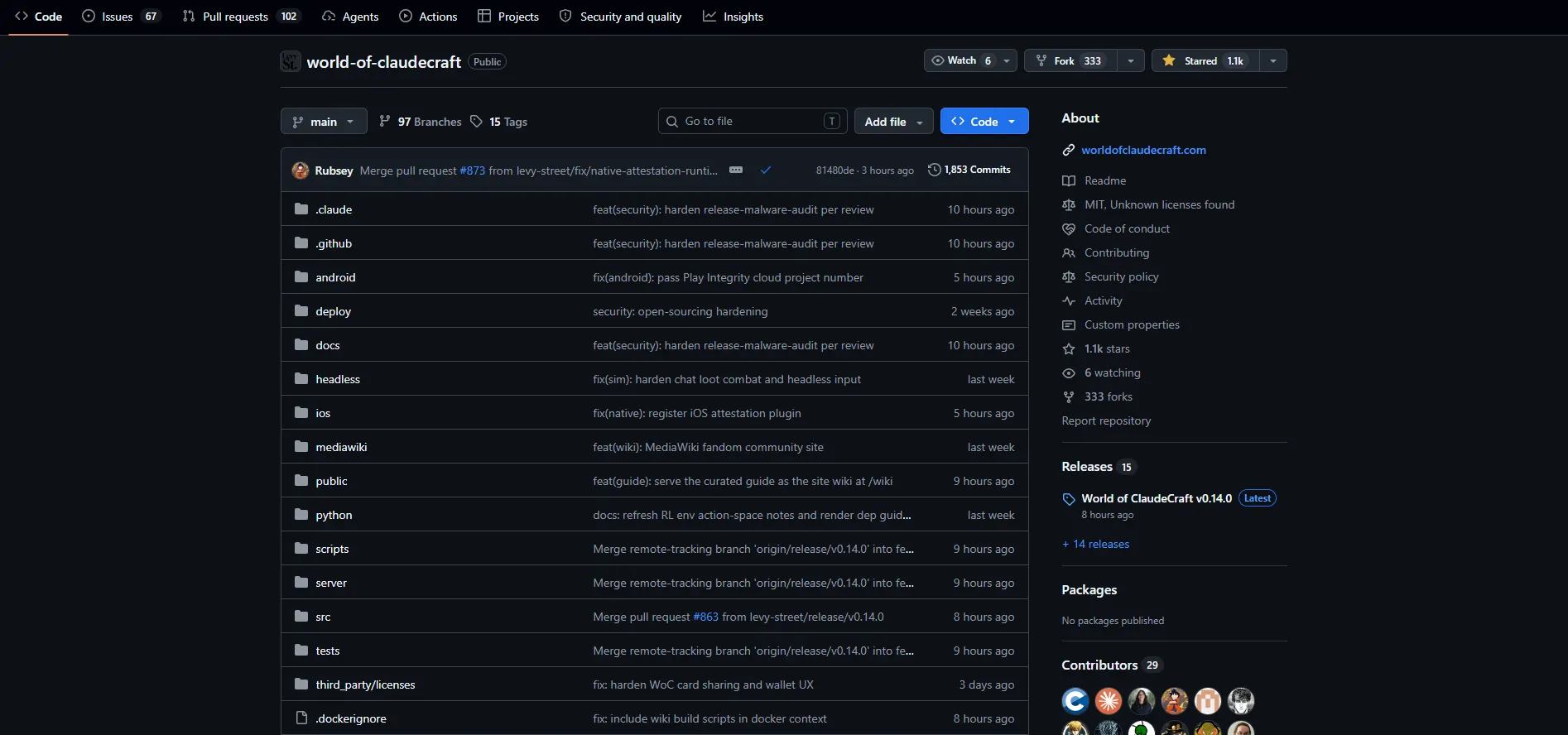
You can browse every line of code, every merged pull request, and every open issue at the World of Claudecraft GitHub repository. What you will find there is not a static archive it is a living, breathing codebase updated multiple times every single day, with developers from across the globe forking the project, experimenting in their own branches, and submitting improvements back upstream.
What Is the Gameplay Experience Actually Like?
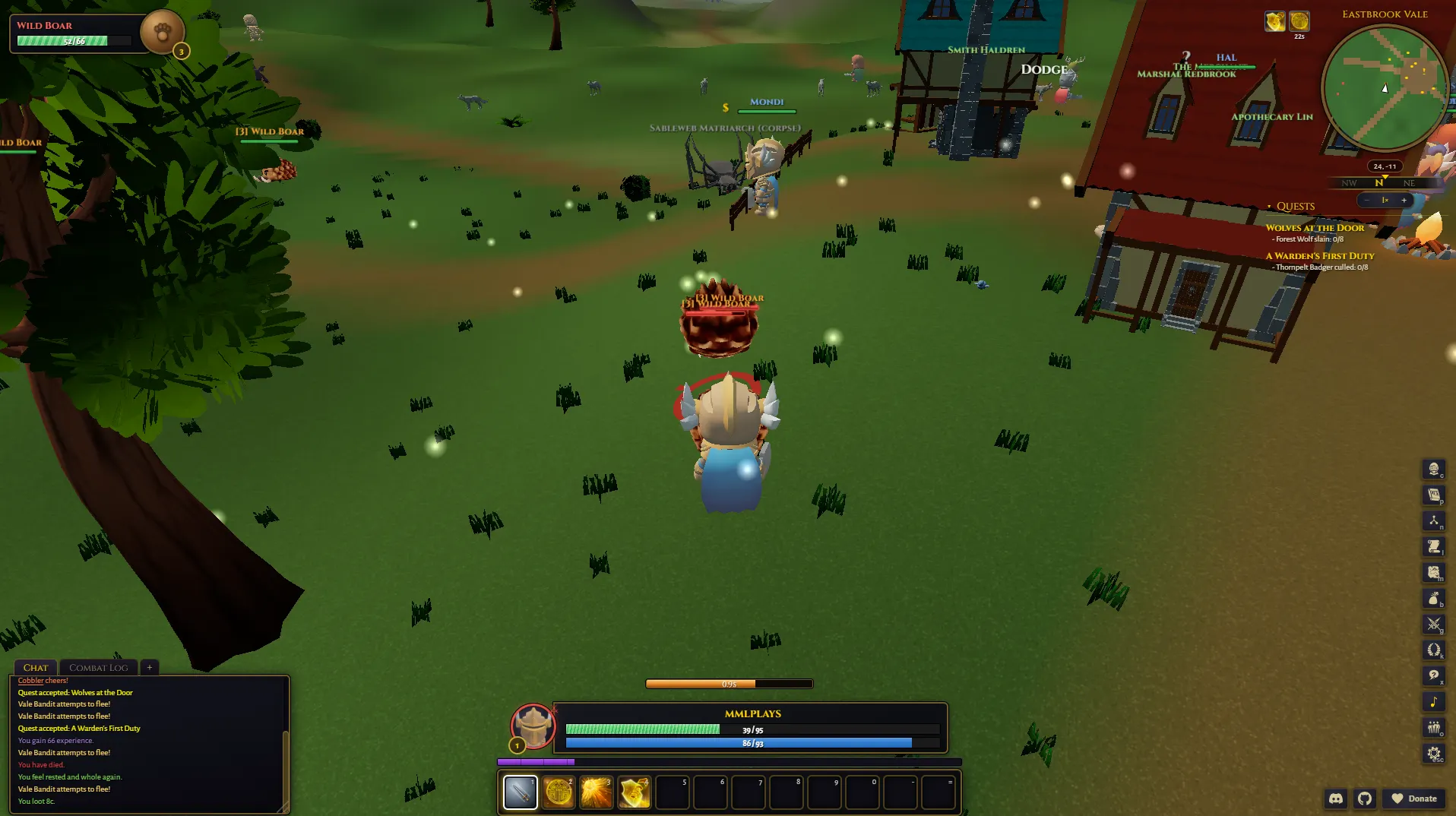
Let us be honest about something that many preview articles gloss over: you will want a decent PC to run World of Claudecraft smoothly. Because almost everything terrain, creature models, sound effects, spell animations is generated on the fly by the client, the CPU and GPU workload is higher than you might expect from a browser game. On older or lower-powered hardware, you may encounter stuttering, especially in busy areas with multiple players. With a modern gaming rig or a reasonably powerful laptop from the last three or four years, however, the experience is genuinely fluid and impressively complete.
And "impressively complete" is not marketing hyperbole. Consider what is actually in the game right now:
- NPC interaction vendors, quest givers, trainers, and lore characters populate towns and the open world. Conversations feel purposeful rather than decorative.
- Group content and dungeons you can party up with friends and tackle instanced dungeon content designed for coordinated group play, echoing the classic "tank, healer, DPS" trinity that defined a generation of MMO design.
- Quest system with nearly 90 quests spread across three zones and tied to an overarching narrative, there is genuine story progression to follow, not just repeating kill-ten-rats errands.
- Open-world travel the zones are traversable on foot (and eventually by mount), with distinct biomes, ambient creatures, and hidden corners that reward exploration.
- Talent trees and character progression 27 unique specialisation paths ensure that two Warriors who level together can end up playing very differently depending on their talent choices.
- Headless RL environment for the developers and AI researchers in the audience, the game exposes a Python-driven Gym interface, meaning you can train reinforcement-learning agents to actually play the game. This is not a footnote; it is a genuinely novel capability for an open-source game project.
Put all of that together and you have something that genuinely deserves the label micro-MMO: smaller in scope than the genre titans, but architecturally faithful and mechanically solid. For a project that did not exist a few months ago, that is astonishing.
The Community That Builds the Game
Here is where World of Claudecraft transcends its technical achievement and becomes something culturally interesting: the gameplay is almost secondary to what is happening around it. The real draw the thing that has people talking, sharing, and coming back every day is the collective act of building something together.
Developers fork the repository, add new quests, tweak class balance, improve UI responsiveness, and submit pull requests. Some contributors have never shipped commercial software. Some are seasoned engineers with decades of experience. Some are students who learned to code in the last year. The common thread is that they all want to add their brick to the wall and see the wall grow taller.
Daily patch notes yes, daily document each increment of improvement. New content drops before the community has even finished exploring the previous update. The pace feels almost reckless by traditional game development standards, yet it works precisely because it is not trying to be a polished commercial product on a release schedule. It is a living experiment, and everyone in it knows that.
"It is not the gameplay anymore that brings people together it is the sense of achievement in what a community can build. Blizzard could learn something from this."
That observation resonates deeply with anyone who has felt like a paying customer rather than a valued member of a game's world. The major MMO publishers spend enormous resources on player retention mechanics daily login rewards, battle passes, season content designed to expire because they know that without artificial incentives, players drift away. World of Claudecraft needs none of that machinery. People show up because the project makes them feel like co-owners, not consumers.
There is a lesson here for the entire games industry. Players do not fundamentally want to be entertained at a fixed price point. Many of them want to matter to contribute to something, to see their idea shipped, to point at a thing and say "I made part of that." Open-source game development, accelerated by AI tooling, might be the model that finally delivers on that impulse at scale.
The $WOC Token on Solana: What You Need to Know
World of Claudecraft is web3-native, meaning it has a built-in relationship with the Solana blockchain through its community token, $WOC. But the implementation is more thoughtful than most blockchain-game integrations you have encountered, and it is worth explaining carefully.
You Do Not Need $WOC to Play
This point cannot be emphasised enough: the token is entirely optional. The full game all nine classes, all three zones, all quests, all dungeons is accessible to every player regardless of whether they hold a single $WOC. There is no pay-to-win, no token-gated content, and no advantage that money can buy. The game's developers have been explicit about this from the start.
What $WOC Actually Does In-Game
If you choose to connect a Solana wallet to your account, the integration works as follows: you link your wallet with a single non-custodial signature (no transaction is required, no SOL is spent), and your read-only $WOC balance then appears in the game's HUD alongside a cosmetic holder-tier badge. The badge changes appearance based on how much $WOC you hold, offering visible community recognition without any gameplay impact. It is a social signal, not a power advantage a distinction that matters enormously in the context of fair game design.
Token Fundamentals
The $WOC token exists on the Solana blockchain with a total and circulating supply of approximately 1 billion tokens. As of late June 2026, the market capitalisation has fluctuated between roughly $470,000 and $1.4 million depending on market conditions, with daily trading volume regularly exceeding $200,000 significant numbers for a project of this age and nature. The token is available on several Solana-native exchanges and aggregators.
It is critical to note and we will state this plainly that $WOC is a speculative community token. Its price is volatile. Nothing in this article constitutes financial advice, and anyone considering holding or trading $WOC should conduct their own research and understand that cryptocurrency markets carry substantial risk. The token's value is driven by community sentiment and adoption, not by any guaranteed utility or underlying revenue.
That said, the way the project has chosen to integrate the token cosmetic-only, wallet-optional, never pay-to-win represents a more respectful model than most blockchain games have managed. The community decides how important the token is; the game itself treats everyone equally.
A Game That AI Agents Can Actually Play
One of the more quietly revolutionary features of World of Claudecraft is its headless reinforcement learning environment. The game exposes a Python Gym interface, meaning that researchers, students, and hobbyist AI engineers can connect software agents to the actual game world, let them learn, and observe how they interact with a complex, persistent environment shared with real human players.
This is not common. Most video games are closed systems that prohibit automation or bot play. World of Claudecraft, being open-source and philosophically committed to experimentation, has built this capability in from the ground up. The same world seed powers the offline browser client, the live multiplayer server, and the headless RL environment meaning an agent trained in isolation is operating in an identical world to the one human players inhabit.
The implications are interesting. Game AI has traditionally been a domain of corporate research labs with proprietary environments (think DeepMind and StarCraft II, or OpenAI and Dota 2). World of Claudecraft opens a small but real window for independent researchers to experiment with multi-agent interaction, emergent social dynamics, and long-horizon task completion in an environment with genuine complexity quests, dungeons, NPC economies, other players without needing access to expensive proprietary systems.
Daily Updates and a Growth Curve That Defies Convention
Traditional game development operates in long cycles: concept, pre-production, production, QA, launch, post-launch support. A major MMO expansion might take two years from announcement to release. World of Claudecraft operates on a completely different cadence: meaningful updates ship daily, sometimes multiple times per day, driven by whatever the most active contributors happen to be working on.
This is both a feature and, at times, a mild source of chaos. Balance changes can arrive without warning. New quest lines appear before existing ones are fully documented. UI improvements and class tweaks stack on top of each other faster than the wiki can keep pace. For players who crave stability and polish above all else, this rapid iteration can feel disorienting. For players who love the energy of something actively becoming, it is intoxicating.
The project's growth reflects this momentum. From a small experiment to a game with thousands of active community members, daily trade volume in its associated token exceeding $200,000, and a GitHub repository receiving contributions from developers on multiple continents World of Claudecraft has scaled faster than most rational projections would have suggested possible.
A standalone desktop launcher is also in development, described on the official site as "coming soon," which would offer optimised performance and full-screen play outside the browser. When that ships, the performance ceiling that currently requires a good PC to push through should drop meaningfully, opening the game to a wider hardware range.
What Big Studios Could Learn From This Experiment
It would be easy to dismiss World of Claudecraft as a novelty a fun AI trick that generates some buzz before fading into the long tail of forgotten indie projects. That dismissal would be a mistake, and it would miss the most important thing this project is demonstrating.
Large game studios Blizzard, EA, Ubisoft have spent the last decade increasingly treating their player bases as revenue targets to be optimised rather than communities to be cultivated. Subscription models gave way to battle passes. Battle passes gave way to seasonal cosmetic stores. In-game economies were engineered to feel rewarding while delivering increasingly less actual content per dollar. Players noticed. Trust eroded. The most dedicated fans of games like World of Warcraft have spent years mourning a game that still technically exists but no longer feels like it belongs to them.
World of Claudecraft, almost accidentally, has done the opposite. By making the source code public, by welcoming pull requests from anyone with something to contribute, by keeping the token cosmetic-only and the game permanently free, the project has created a space where players feel like stakeholders rather than subscribers. That feeling of ownership, of contribution, of genuine community is the thing no amount of marketing spend can manufacture.
The budget constraints that forced these choices were real. This was not a well-funded studio making principled decisions from a position of strength. It was a small team using AI tooling to do what would have previously required millions of dollars and years of labour, then opening the result to the world because that was the fastest path to growth. But the accidental lesson is the same regardless of the motive: players who feel special create communities; players who feel monetised create churn.
Whether any major studio has the institutional courage to act on that lesson is a different question. But the data from projects like World of Claudecraft is starting to accumulate, and it is hard to ignore.
How to Get Started With World of Claudecraft Today
Getting into World of Claudecraft requires no installation, no credit card, and no technical knowledge. The path is deliberately simple:
- Visit the official site at worldofclaudecraft.com. The game loads in your browser no plugin required.
- Click "Play Offline" for an immediate solo experience with no account needed. Name your character, choose one of the nine available classes (Warrior, Rogue, Mage, Hunter, Paladin, Warlock, Priest, Druid, or Shaman), and you will land in Eastbrook Vale within seconds.
- Create an account to access the shared multiplayer world, persistent character progression, and all social features. Registration is free.
- Optionally connect a Solana wallet if you hold $WOC and want to display your holder badge. This requires a single read-only signature no transaction, no SOL spending.
- If you are a developer, head to the GitHub repository, fork the project, and start experimenting. The README is comprehensive, the community is welcoming, and your pull request could be in production by tomorrow.
The one genuine caveat worth repeating: aim for a modern PC if you want the smoothest experience. The runtime-generated assets are visually impressive but CPU-intensive. On a low-powered machine you may encounter slowdowns in populated areas. The development team is actively working on performance optimisation, and the forthcoming standalone launcher should bring meaningful improvements.
Final Thoughts: A Small Game With a Big Idea
World of Claudecraft is not going to dethrone World of Warcraft this year, or next year, or perhaps ever. That is not the point. What it is doing is demonstrating with real players, real code, and a real community that AI-assisted development can compress the timeline from idea to playable experience in ways that fundamentally change who gets to make games.
It is also demonstrating that the most powerful retention mechanic in gaming has nothing to do with monetisation design or content drip-feed schedules. It is the simple, ancient human desire to build something with other people and feel proud of what you made together. The developers at World of Claudecraft did not discover a new insight. They just provided the scaffolding for it to happen, and then got out of the way.
If you have any interest in the future of games, the trajectory of AI-assisted software development, or the question of what online communities can accomplish when they are given the tools and the trust to create World of Claudecraft is worth your time. Go play it, go read the code, or simply go read the patch notes and watch something be built in real time. It is unlike anything else happening in gaming right now.
Start exploring at worldofclaudecraft.com and contribute to the future of the game at github.com/levy-street/world-of-claudecraft.
Disclaimer: Nothing in this article constitutes financial or investment advice. The $WOC token is a speculative digital asset; its price is volatile and past performance is not indicative of future results. Always do your own research before interacting with any cryptocurrency.


