

SpaceX has officially entered one of the most interesting conversations in the AI coding space after announcing that it has exercised the option to acquire Cursor in an all-stock transaction. According to the announcement, the goal is ambitious: building the world’s most useful AI models, with SpaceXAI and Cursor already working together on a jointly trained model expected to appear in Cursor and Grok Build.
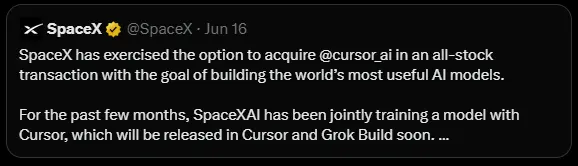
From my point of view, this is not just another tech acquisition headline. Cursor is not a simple code editor anymore. For many developers, it has already become a daily AI coding environment, especially for people who build fast, prototype aggressively, and rely on AI assistance to move through repetitive implementation work. If SpaceXAI can combine Cursor’s developer workflow data with Grok Build and its own AI infrastructure, the result could become a very serious competitor in the AI development tools market.
Why the Cursor acquisition matters
Cursor became popular because it sits directly inside the coding workflow. Instead of asking an AI model questions in a separate browser tab, developers can use Cursor to read files, modify code, explain errors, generate implementations, and refactor projects inside the editor itself. This makes the acquisition more strategic than it may look at first glance.
SpaceX is not only buying a product. It is buying a workflow, a developer audience, and a practical interface where AI models are tested against real coding problems every day. That matters because the future of AI coding will not be won only by the model with the best benchmark score. It will also be won by the tool that developers actually keep open for hours while building real software.
This is why the mention of Grok Build is important. If Cursor and Grok Build begin sharing model improvements, agentic coding features, and deeper project-level understanding, developers could see a more integrated AI development experience. In theory, this could mean better code generation, stronger debugging, better file awareness, and more useful project-wide reasoning.
The Rise of AI-Native Code Editors
Over the last three years, the software development industry has experienced one of the fastest productivity shifts in its history. Developers who once relied exclusively on documentation, Stack Overflow discussions, GitHub repositories, and traditional search engines now routinely work alongside AI assistants capable of generating code, explaining bugs, writing tests, and even designing complete application architectures.
What makes Cursor particularly interesting is that it emerged during a period when developers were beginning to realize that simply embedding a chatbot inside an editor was not enough. The next generation of AI development tools needed to understand entire projects, maintain context across multiple files, analyze dependencies, and reason about architecture rather than individual snippets of code.
This is where Cursor differentiated itself from many early competitors. Rather than acting as a simple autocomplete assistant, it attempted to become a development partner capable of understanding larger objectives. Developers could ask questions about entire projects, request modifications spanning dozens of files, and receive suggestions based on broader application context.
That distinction is important because the future of software development is unlikely to revolve around who has the fastest autocomplete. Instead, it will likely revolve around which platform can provide the most useful understanding of a complete software system. This makes the acquisition significantly more strategic than simply purchasing a successful application.
How Cursor Changed Developer Workflows
Before AI-assisted development tools became mainstream, software engineering typically involved frequent context switching. A developer might write code, encounter an error, search documentation, open multiple browser tabs, compare examples, return to the editor, and repeat the process dozens of times throughout the day.
AI coding assistants began reducing that friction, but Cursor pushed the concept further by integrating deeper project awareness into the development workflow. Instead of searching for solutions externally, developers could interact with the AI directly inside the environment where the problem existed.
This may sound like a small convenience, but at scale it can represent a meaningful productivity improvement. Saving even a few minutes per hour compounds significantly over weeks, months, and years of software development. Organizations increasingly recognize this value, which helps explain why AI-assisted development tools have attracted substantial investment across the industry.
From startups building MVPs to enterprise teams maintaining legacy systems, the demand for tools that reduce development friction continues to grow. Cursor successfully positioned itself at the center of this trend.
What SpaceX Is Really Buying
When large technology organizations acquire software companies, the public often focuses on the product itself. However, acquisitions frequently involve much more than technology. In many cases, the most valuable assets are the user base, accumulated knowledge, workflow integration, engineering talent, and market position.
In Cursor's case, SpaceX is not merely acquiring an editor. It is potentially acquiring access to one of the most engaged communities of AI-assisted developers currently operating in the market. Every day, thousands of developers use Cursor to solve real software engineering problems across a wide range of technologies and industries.
This creates a valuable feedback loop. AI models improve when they are exposed to practical use cases, realistic coding scenarios, and genuine developer workflows. A platform that sits directly inside the software development process becomes an ideal environment for testing, refining, and improving future AI systems.
Viewed through this lens, the acquisition appears less like a software purchase and more like an investment in the future training and deployment infrastructure of AI-powered development tools.
The AI Coding Arms Race Is Accelerating
The timing of this acquisition is also noteworthy because competition in the AI coding space has intensified dramatically. OpenAI continues to expand coding capabilities inside ChatGPT. Anthropic's Claude has become a favorite among many developers for reasoning-heavy tasks. GitHub Copilot remains deeply integrated into professional development environments. Google's Gemini continues to receive significant investment and integration across the Google ecosystem.
Meanwhile, newer entrants continue to emerge, each attempting to establish a unique advantage through workflow integration, model performance, pricing strategies, or specialized capabilities.
This environment makes developer attention one of the most valuable resources in the AI industry. Developers influence purchasing decisions, build products consumed by millions of users, and often act as early adopters who shape broader technology trends.
By acquiring Cursor, SpaceX immediately gains a stronger position in one of the most strategically important segments of the AI market.
Potential Benefits for Developers
If the integration between Cursor and Grok Build progresses successfully, developers could potentially benefit from several improvements. Better project understanding may reduce the need to repeatedly explain context to the AI. More sophisticated reasoning could improve debugging quality and architectural recommendations. Enhanced multi-file awareness may allow larger changes to be performed more reliably.
Developers increasingly expect AI tools to understand entire repositories rather than isolated files. They want assistants capable of reasoning about application architecture, database structures, API interactions, deployment pipelines, and infrastructure configuration simultaneously.
Meeting those expectations requires substantial investment in both models and tooling. A combined Cursor and SpaceXAI effort could potentially accelerate progress in those areas.
Of course, these benefits remain speculative until actual products and features are released. Nevertheless, the acquisition suggests that both companies see substantial value in pursuing deeper AI-assisted development workflows.
The Enterprise Opportunity
While many discussions focus on individual developers, enterprise customers may ultimately represent an even larger opportunity. Large organizations spend millions of dollars annually on software development, maintenance, documentation, testing, security reviews, and onboarding processes.
AI systems capable of reducing development costs by even a small percentage can generate enormous savings at enterprise scale. This explains why companies continue investing heavily in AI development platforms despite growing competition.
A mature AI coding environment that integrates development workflows, project understanding, documentation generation, testing, and debugging could become an essential component of modern software engineering teams.
From this perspective, the acquisition appears aligned with broader industry trends that increasingly position AI as a core productivity layer rather than an optional enhancement.
The Open Source Question
Another aspect worth considering is the impact on open-source development. Many AI-assisted coding platforms derive value from publicly available software projects, documentation, examples, and community-driven knowledge bases.
Developers in the open-source ecosystem have expressed both excitement and concern regarding AI-assisted development tools. On one hand, these tools can dramatically accelerate contributions and reduce barriers to entry. On the other hand, questions remain regarding attribution, licensing, training data, and long-term sustainability.
As larger organizations acquire increasingly influential development platforms, transparency surrounding these issues may become more important than ever. Developers are likely to continue demanding clarity regarding how AI systems are trained, how generated code should be used, and how intellectual property concerns are addressed.
What Happens Next?
The acquisition announcement provides an intriguing glimpse into a possible future, but many important questions remain unanswered. Will Cursor continue operating independently? Will pricing remain unchanged? How deeply will Grok Build become integrated into the development experience? Will enterprise offerings evolve? Could future models become exclusive to the platform?
At this stage, the industry has more questions than answers. However, one conclusion already appears reasonable: AI-assisted software development remains one of the most competitive and strategically important technology sectors today.
Whether the acquisition ultimately succeeds will depend not only on model quality but also on execution, developer trust, product integration, and the ability to deliver meaningful improvements to real-world workflows.
For now, developers should view the announcement as a significant industry development rather than an immediate change to their subscriptions or access rights. The technology implications may be substantial, but the practical details surrounding pricing, account access, and bundled services have not changed based solely on the acquisition announcement.
The catch: this does not mean one subscription unlocks everything
The part that needs to be made very clear is this: the acquisition announcement does not automatically mean that one subscription gives access to the whole stack. Some users immediately started wondering whether X Premium, Grok, Cursor, and third-party models such as Claude would become part of one combined subscription. Based on the available information, that is not what has been announced.

Cursor currently has its own pricing page and subscription structure. X Premium also has its own subscription tiers and feature list. The public acquisition post does not say that Cursor will be bundled with X Premium, and it does not say that Claude access is included through X Premium either. That distinction is important because AI subscriptions are already confusing enough for normal users, creators, and developers.
In practical terms, a user should not assume that paying for X Premium means they automatically receive Cursor Pro, Cursor Ultra, Claude access, or unlimited AI coding features. Unless SpaceX, X, Cursor, or Grok officially announce a bundled plan later, these should be treated as separate products with separate access rules.
Why people are confused
The confusion is understandable. The modern AI ecosystem is becoming a stack of connected brands: X, Grok, SpaceXAI, Cursor, and multiple third-party AI model providers. When a company announces that its AI team is working with a coding tool and that a new model will appear in both Cursor and Grok Build, many users naturally assume that subscriptions may also merge.
But product integration and subscription bundling are not the same thing. A model can be available in multiple tools without those tools sharing the same paid plan. A company can own or partner with another company without instantly merging billing, account access, model limits, or enterprise contracts. This is exactly where users need to slow down and read the details instead of relying on hype.
My personal take as a developer
As someone who follows AI tools from a developer and creator perspective, I see this acquisition as both exciting and slightly risky. It is exciting because Cursor already understands what developers need: fast edits, context-aware code changes, terminal-aware workflows, and project-level assistance. If SpaceXAI adds stronger model capability on top of that, Cursor could become even more useful.
At the same time, I do not want the AI coding market to become more confusing for users. Developers already have to compare ChatGPT, Claude, Grok, Gemini, Cursor, Windsurf, Copilot, and local models. If every tool becomes part of a larger subscription ecosystem without clear limits, the average user will have a hard time understanding what they are actually paying for.
This is why the community note matters. It adds a necessary correction to the hype. The acquisition may be real, the AI model collaboration may be important, and Cursor may become more deeply connected with Grok Build, but that still does not mean X Premium includes Cursor or Claude.
What this could mean for creators and developers
For developers, the best-case scenario is simple: better AI coding models inside Cursor, stronger project understanding, and more reliable agentic development tools. For creators, educators, and streamers who build tools, websites, overlays, bots, or automation scripts, a more powerful Cursor could reduce development time and make complex projects easier to manage.
This also connects with the wider trend of AI becoming part of daily digital work. On StreamRSC, I already cover topics around AI tools, apps and technology, and developer tools. The Cursor acquisition fits directly into that space because it is not only about AI research. It is about how AI enters the real workflow of people who actually build things.
Final thoughts
SpaceX acquiring Cursor is a major signal that AI coding tools are becoming strategically important, not just useful side-products. Cursor has already proven that developers want AI inside their editor, not only inside a chatbot. If the upcoming joint model performs well inside Cursor and Grok Build, this could become one of the most important AI developer tool moves of the year.
But the catch remains important: do not treat the acquisition as a subscription bundle announcement. X Premium does not currently include Cursor, Cursor has its own pricing, and Claude is not included just because people associate it with AI coding workflows. Until an official bundled plan is announced, users should treat each service separately and check the pricing pages before subscribing.


